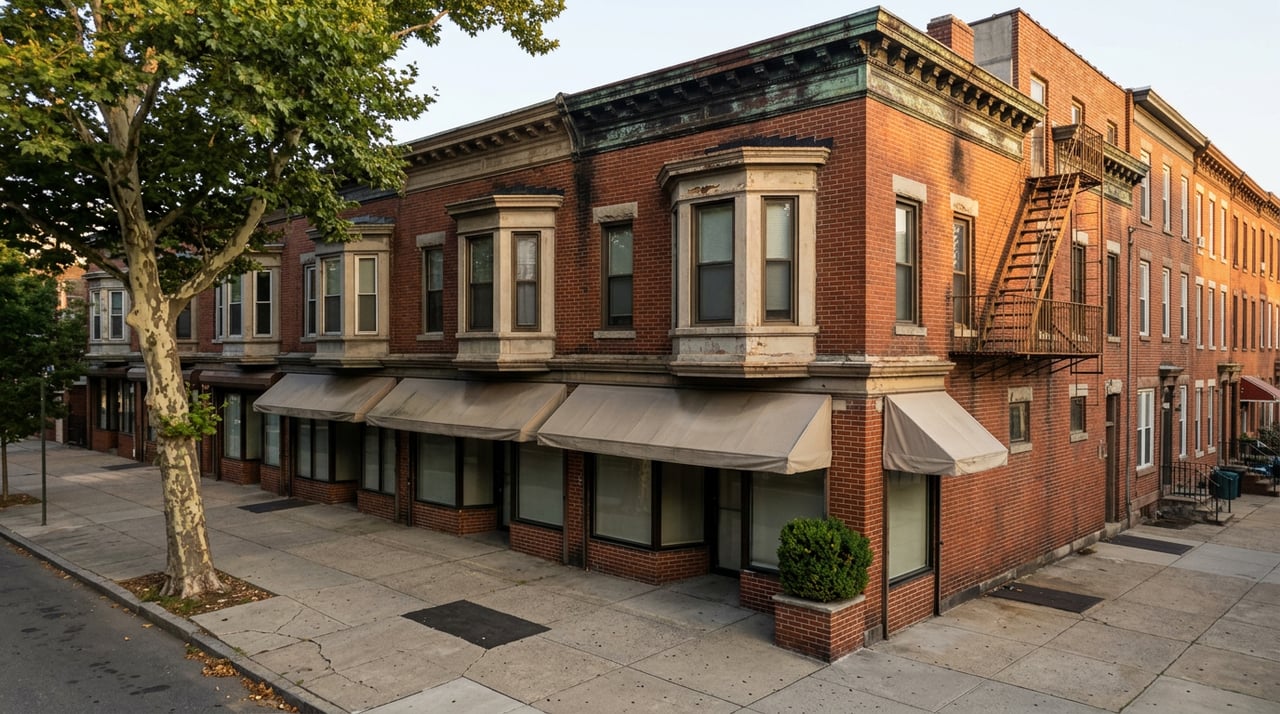
Walk Bergenline Avenue on a Tuesday afternoon and you'll pass a Cuban cafeteria that's been in the same family since 1974, a churro counter that's been frying since before most of its regulars were born, and a pizza spot that opened only in the last few years serving Philly cheesesteaks next to empanadas. None of that is an accident of gentrification or a sign the neighborhood is finally "arriving." Bergenline has been doing this same trick for over a century, and the trick isn't holding onto one identity. It's swapping identities without ever losing a beat.
That's the part most guides to Union City skip. They'll tell you Bergenline is "Havana on the Hudson," full stop, like the street is a museum exhibit that opened in 1959 and has stayed exactly the same since. The actual history is stranger and more useful to know if you live here: the avenue has changed its dominant culture roughly every generation, and the storefronts never went dark in between.
The Street Has Had Three Dominant Cultures
Bergenline started as a literal cowpath. According to the historical record on the avenue, streetcar tracks were originally slated for Palisade Avenue, until a resident named Henry Kohlmeier, who'd just built his house there, objected to the noise and got the tracks rerouted two blocks over. That rerouting is the reason Bergenline exists as a commercial strip at all.
By the early twentieth century it had become an Italian-American retail strip. By 1981 it was predominantly Cuban, the wave of post-revolution immigration that gave North Hudson its "Havana on the Hudson" nickname. Today the mix has broadened again, Central and South American and Caribbean businesses sitting next to the Cuban institutions that made the avenue famous, which is why longtime residents still sometimes just call it "La Avenida," no cultural modifier needed. Today it's the longest commercial avenue in New Jersey, with more than 300 stores and restaurants packed along a corridor that runs one-way and narrow through most of Union City before widening near the North Bergen line.
Three different dominant cultures, one continuous run of storefronts. That continuity, not any single era, is what makes the avenue feel the way it does.
What Actually Survived Each Handoff
The businesses that outlasted the cultural turnover are the real proof of the pattern. El Artesano, at 4101 Bergenline, has been family-owned since 1974, run today by Felix and Ignacio Alfonso, serving the same pernil, croquetas, and Cuban sandwiches through five decades of a neighborhood that kept changing shape around it. It's open until midnight on weekends, which tells you something about who the avenue expects to be feeding at that hour.
A few blocks south, La Gran Via has been pouring cortaditos at 3905 Bergenline since long before "Cuban coffee" became a phrase non-Cubans recognized. La Churreria still fries fresh churros on the spot, thin and crunchy, sugar only, no cinnamon, a house style that regulars will defend to strangers.
None of these places opened because Bergenline was trendy. They opened because the avenue has always rewarded whoever shows up next with foot traffic, and that arrangement hasn't changed even as the businesses filling the storefronts have.
Two Parks, Two Different Jobs
Union City's public spaces split the same way the avenue's history does, between what's lived daily and what's built to be remembered.
Jose Marti Park does the daily work. It's where you'll find a game of dominoes running at pretty much any hour, an informal fixture that doesn't need a schedule because it never really stops.
Celia Cruz Park does the memorial work. Its Walk of Fame, dedicated in 2004 in a ceremony attended by Cruz's husband Pedro Knight, has grown into a set of marble stars honoring the musicians who defined the sound of this community for decades. The honorees include:
- Tito Puente
- Johnny Pacheco
- Israel "Cachao" López
- Beny Moré
- La India
- news anchor Rafael Pineda
One park is where the neighborhood shows up. The other is where it decided who's earned a permanent place in the story.
The Art Scene Isn't New, It's Just Getting a Building
Union City has officially designated September as Celebrate Art Month, and the city has been backing that up with actual infrastructure. The UC Art Sculpture, designed by artist Lucio Fernandez, went up on Bergenline between 30th and 31st Streets, marking the site of a planned Plaza of the Arts that the city has been working toward.
That civic push connects to something already happening quietly on the ground. Cuban sculptor Adrián Fernández Milanés set up his studio in the historic R.H. Simon Silk Mill, a building doing exactly what old industrial mills do in cities like this: giving artists room they couldn't afford across the river. In an interview with Untapped Cities, asked about trading Manhattan for Union City, he put it simply.
"It's not Manhattan, but it's close enough. And here, there's space to start over."
There's no PATH stop near the mill, a point he made in the interview. The same lack of direct transit access that keeps Union City off some commuter checklists is part of the neighborhood context in which its art scene is taking shape.
Right Now, Specifically
If you're reading this in the back half of September, you're already inside Hispanic Heritage Month, which runs citywide from September 15 through October 15. It's not a single event so much as a monthlong layer over everything already happening on the avenue, the same restaurants, the same parks, with the added weight of a formal citywide observance running underneath.
It follows the same rhythm as Union City's Cuban Independence Day Celebration, held every May 20 with a midday flag-raising at International Plaza and an evening dinner at Jose Marti Park. Neither event tries to reinvent the avenue for the occasion. Both just point a spotlight at what's already there.
Why the Avenue Never Actually Goes Dark
Put the pieces together and the pattern is obvious once you see it. Bergenline survived a streetcar rerouting, an Italian-American retail era, a Cuban-dominant era, and a broader Latin American present, and at no point did the storefronts sit empty long enough for the avenue to lose its identity as a place people go to eat, shop, and be seen. The businesses changed hands. The parks kept doing their separate jobs, one for daily life, one for permanent memory. The art scene didn't arrive with a ribbon-cutting, it was already living in a silk mill, and the city is just now building it a plaza.
That's the thing about Bergenline that a postcard version of "Havana on the Hudson" can't capture. The avenue isn't preserved. It's inherited, handed from one generation and one culture to the next, and the handoff has never once required the lights to go out.
If you're the kind of person who wants to understand a neighborhood at this level, block by block, era by era, rather than settling for the highlight reel, that's the same approach Keys With Sonia brings to every conversation about Hudson County, whether you're a longtime Bergenline regular or just curious about what's changed on your own block. Let's connect.